 Francisco Geiman Thiesen
42c047a927
Francisco Geiman Thiesen
42c047a927
The dominant cost in the reflection serializer was the strict-aliasing
reload pattern: every char* write through `string_builder::buffer.get()`
forced the compiler to assume `string_builder::position` and `::capacity`
may have been clobbered, so it reloaded both members from memory after
each byte. perf annotate showed `ldr [position]` and `ldr [capacity]`
taking 15-20% of CITM serialization time.

This change refactors the reflection atom path to use an internal
`writer` struct (buffer pointer + position + capacity + back-ref to
string_builder). The writer lives as a stack-local in the top-level
append() entry point, threaded through the inlined atom() chain via
`writer&`. After SROA, the three fields are register-resident across
the entire serialization. The `pos` is never round-tripped through
memory between writes — it's a local size_t.

This mirrors the pattern Glaze uses (passing `B&& b, auto&& ix` through
every helper). The simdjson-specific bit is keeping the public
string_builder API intact: only the internal atom() family is
refactored to take `writer&`. The top-level append(string_builder&, T)
constructs a writer on the stack, threads it through atom(), then
syncs the local position back at the end.

For string fields specifically, the escape path is also inlined
through the writer — the existing `write_string_escaped(input, out)`
helper already takes a destination pointer and returns bytes-written,
so it composes cleanly with `w.ptr + w.pos`. Without this, sync/
reload around each string write was a real cost on Twitter (-7%).

Performance
===========

TRUE A/B in single docker invocation, 7 alternating rounds, byte-
identical output, all static_reflection_comprehensive_tests pass.
Build: clang-p2996 21.0.0git, -O3 -DNDEBUG, aarch64 Linux.

CITM Catalog (496 682 bytes):
  baseline (master): 4356 MB/s
  patched:           6776 MB/s   +55.5%
  Glaze:             4860 MB/s   simdjson now 39.4% AHEAD of Glaze

Twitter (81 927 bytes):
  baseline (master): 6437 MB/s
  patched:           6452 MB/s   +0.2% (break-even)
  Twitter is string-heavy; the writer's gain over the existing
  member-based path is small here, but it no longer regresses.

Default initial capacity is unchanged at 1024.



simdjson : Parsing gigabytes of JSON per second

JSON is everywhere on the Internet. Servers spend a lot of time parsing it. We need a fresh approach. The simdjson library uses commonly available SIMD instructions and microparallel algorithms to parse JSON 4x faster than RapidJSON and 25x faster than JSON for Modern C++.
- Fast: Over 4x faster than commonly used production-grade JSON parsers.
- Record Breaking Features: Minify JSON at 6 GB/s, validate UTF-8 at 13 GB/s, NDJSON at 3.5 GB/s.
- Easy: First-class, easy to use and carefully documented APIs.
- Strict: Full JSON and UTF-8 validation, lossless parsing. Performance with no compromises.
- Automatic: Selects a CPU-tailored parser at runtime. No configuration needed.
- Reliable: From memory allocation to error handling, simdjson's design avoids surprises.
- Peer Reviewed: Our research appears in venues like VLDB Journal, Software: Practice and Experience.
This library is part of the Awesome Modern C++ list.
Table of Contents
- Real-world usage
- Quick Start
- Documentation
- Godbolt
- Performance results
- Packages
- Bindings and Ports of simdjson
- About simdjson
- Funding
- Contributing to simdjson
- License
Real-world usage
- Node.js
- ClickHouse
- Meta Velox
- Google Pax
- milvus
- QuestDB
- Clang Build Analyzer
- Shopify HeapProfiler
- StarRocks
- Microsoft FishStore
- Intel PCM
- WatermelonDB
- Apache Doris
- Dgraph
- UJRPC
- fastgltf
- vast
- ada-url
- fastgron
- WasmEdge
- RonDB
- GreptimeDB
- mamba
- Ladybird Browser
- SereneDB
If you are planning to use simdjson in a product, please work from one of our releases.
Quick Start
The simdjson library is easily consumable with a single .h and .cpp file.
-
Prerequisites:
g++(version 7 or better) orclang++(version 6 or better), and a 64-bit system with a command-line shell (e.g., Linux, macOS, freeBSD). We also support programming environments like Visual Studio and Xcode, but different steps are needed. Users of clang++ may need to specify the C++ version (e.g.,c++ -std=c++17) since clang++ tends to default on C++98. -
Pull simdjson.h and simdjson.cpp into a directory, along with the sample file twitter.json. You can download them with the
wgetutility:wget https://raw.githubusercontent.com/simdjson/simdjson/master/singleheader/simdjson.h https://raw.githubusercontent.com/simdjson/simdjson/master/singleheader/simdjson.cpp https://raw.githubusercontent.com/simdjson/simdjson/master/jsonexamples/twitter.json -
Create
quickstart.cpp:
#include <iostream>
#include "simdjson.h"
using namespace simdjson;
int main(void) {
    ondemand::parser parser;
    padded_string json = padded_string::load("twitter.json");
    ondemand::document tweets = parser.iterate(json);
    std::cout << uint64_t(tweets["search_metadata"]["count"]) << " results." << std::endl;
}
c++ -o quickstart quickstart.cpp simdjson.cpp./quickstart
100 results.
Documentation
Usage documentation is available:
- Basics is an overview of how to use simdjson and its APIs.
- Builder is an overview of how to efficiently write JSON strings using simdjson.
- Performance shows some more advanced scenarios and how to tune for them.
- Implementation Selection describes runtime CPU detection and how you can work with it.
- API contains the automatically generated API documentation.
- Compile-Time Parsing presents our compile-time parsing function (C++26 only).
Godbolt
Some users may want to browse code along with the compiled assembly. You want to check out the following lists of examples:
- C++26 reflection example
- simdjson examples with errors handled through exceptions
- simdjson examples with errors without exceptions
Performance results
The simdjson library uses three-quarters less instructions than state-of-the-art parser RapidJSON. To our knowledge, simdjson is the first fully-validating JSON parser to run at gigabytes per second (GB/s) on commodity processors. It can parse millions of JSON documents per second on a single core.
The following figure represents parsing speed in GB/s for parsing various files on an Intel Skylake processor (3.4 GHz) using the GNU GCC 10 compiler (with the -O3 flag). We compare against the best and fastest C++ libraries on benchmarks that load and process the data. The simdjson library offers full unicode (UTF-8) validation and exact number parsing.

The simdjson library offers high speed whether it processes tiny files (e.g., 300 bytes) or larger files (e.g., 3MB). The following plot presents parsing speed for synthetic files over various sizes generated with a script on a 3.4 GHz Skylake processor (GNU GCC 9, -O3).

All our experiments are reproducible.
For NDJSON files, we can exceed 3 GB/s with our multithreaded parsing functions.
Packages

Bindings and Ports of simdjson
We distinguish between "bindings" (which just wrap the C++ code) and a port to another programming language (which reimplements everything).
- ZippyJSON: Swift bindings for the simdjson project.
- libpy_simdjson: high-speed Python bindings for simdjson using libpy.
- pysimdjson: Python bindings for the simdjson project.
- cysimdjson: high-speed Python bindings for the simdjson project.
- simdjson-rs: Rust port.
- simdjson-rust: Rust wrapper (bindings).
- SimdJsonSharp: C# version for .NET Core (bindings and full port).
- simdjson_nodejs: Node.js bindings for the simdjson project.
- simdjson_php: PHP bindings for the simdjson project.
- simdjson_ruby: Ruby bindings for the simdjson project.
- fast_jsonparser: Ruby bindings for the simdjson project.
- simdjson-go: Go port using Golang assembly.
- rcppsimdjson: R bindings.
- simdjson_erlang: erlang bindings.
- simdjsone: erlang bindings.
- lua-simdjson: lua bindings.
- hermes-json: haskell bindings.
- zimdjson: Zig port.
- simdjzon: Zig port.
- JSON-Simd: Raku bindings.
- JSON::SIMD: Perl bindings; fully-featured JSON module that uses simdjson for decoding.
- gemmaJSON: Nim JSON parser based on simdjson bindings.
- simdjson-java: Java port.
- mruby-fast-json: mruby binding with high API coverage.
About simdjson
The simdjson library takes advantage of modern microarchitectures, parallelizing with SIMD vector instructions, reducing branch misprediction, and reducing data dependency to take advantage of each CPU's multiple execution cores.
Our default front-end is called On-Demand, and we wrote a paper about it:
- John Keiser, Daniel Lemire, On-Demand JSON: A Better Way to Parse Documents?, Software: Practice and Experience 54 (6), 2024.
Some people enjoy reading the first (2019) simdjson paper: A description of the design and implementation of simdjson is in our research article:
- Geoff Langdale, Daniel Lemire, Parsing Gigabytes of JSON per Second, VLDB Journal 28 (6), 2019.
We have an in-depth paper focused on the UTF-8 validation:
- John Keiser, Daniel Lemire, Validating UTF-8 In Less Than One Instruction Per Byte, Software: Practice & Experience 51 (5), 2021.
We also have an informal blog post providing some background and context.
For the video inclined, we had a talk at QCon San Francisco 2019
(It was the best voted talk, we're kinda proud of it.)
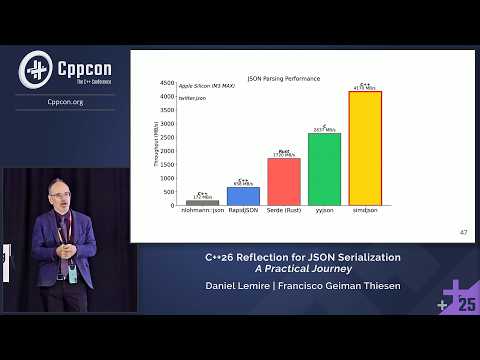
We also had a CppCon 2025 talk. We show how C++26 reflection allows for one-line serialization (to_json(player)) or deserialization—without invasive macros or manual mapping—using nothing but the C++ standard library. Whether you’re a performance junkie or simply interested in the roadmap for the next decade of C++ development, watch our full talk!
Citing this work
If you use simdjson in published research, please cite the software library. A suitable BibTeX entry is:
@misc{simdjson,
  title={{The simdjson library: Parsing Gigabytes of JSON per Second}},
  author={Daniel Lemire and Geoff Langdale and John Keiser and Paul Dreik and Francisco Thiesen and others},
  year={2019},
  howpublished={Software library},
  note={https://github.com/simdjson/simdjson}
}
Funding
The work is supported by the Natural Sciences and Engineering Research Council of Canada under grants RGPIN-2017-03910 and RGPIN-2024-03787.
Contributing to simdjson
Head over to CONTRIBUTING.md for information on contributing to simdjson, and HACKING.md for information on source, building, and architecture/design.
Stars
License
This code is made available under the Apache License 2.0 as well as under the MIT License. As a user, you can pick the license you prefer.
Under Windows, we build some tools using the windows/dirent_portable.h file (which is outside our library code): it is under the liberal (business-friendly) MIT license.
For compilers that do not support C++17, we bundle the string-view library which is published under the Boost license. Like the Apache license, the Boost license is a permissive license allowing commercial redistribution.
For efficient number serialization, we bundle Florian Loitsch's implementation of the Grisu2 algorithm for binary to decimal floating-point numbers. The implementation was slightly modified by JSON for Modern C++ library. Both Florian Loitsch's implementation and JSON for Modern C++ are provided under the MIT license.
For runtime dispatching, we use some code from the PyTorch project licensed under 3-clause BSD.