
23 KiB
Table of Contents
Symbolic Execution
Chapter Tracing explained how to collect a concrete execution trace of your
target, which in our specific case is the ARMv7 binary circled. If you followed along the given
instructions, this trace was stored in the file circled.yaml. As we will see below, this trace
file may then be used as input for the different analysis modules implemented by
Morion. These analysis modules execute the
collected trace symbolically, which then allows for reasoning about the target's behavior by
solving constraints for specified mathematical problems. An example for such a problem might for
instance be the question of whether or not it is possible for the program counter (register pc) to
become a certain value, and if so, how this can be achieved (e.g. leading to a control-flow
hijacking condition).

Setup
Before running one of Morion's symbolic analysis
modules, the collected trace file circled.yaml might optionally be customized. Such
customizations could for example be to:
- Mark (additional) register values or memory locations as being symbolic (in the entry state)
- Modify the parameter
modeof hooked functions - Add/remove assembly instructions to/from the trace
- Add extra inputs for analysis modules (e.g. intended ROP chains for analysis module
morion_rop_generator, see e.g. chapter Exploitation)
In our documented example of the binary circled, all relevant configurations have already been
defined in the file circled.init.yaml, which during tracing got
copied over to the file circled.yaml. Therefore, no further customizations are needed.
Run
Use the following step to symbolically execute a previously collected trace from a concrete execution run of binary circled:
- Use morion to execute the collected trace symbolically:
- System: Analysis / Host (morion)
- Command:
cd morion/;             # Ensure to be within the correct directory
morion -h;              # Optionally show usage help
morion circled.yaml;    # Execute program trace symbolically
Remember that if you followed along the instructions in chapter Tracing, the trace was collected while the vulnerable binary processed a sample payload leading to a crasher/segfault (as might have been identified by a fuzzer).
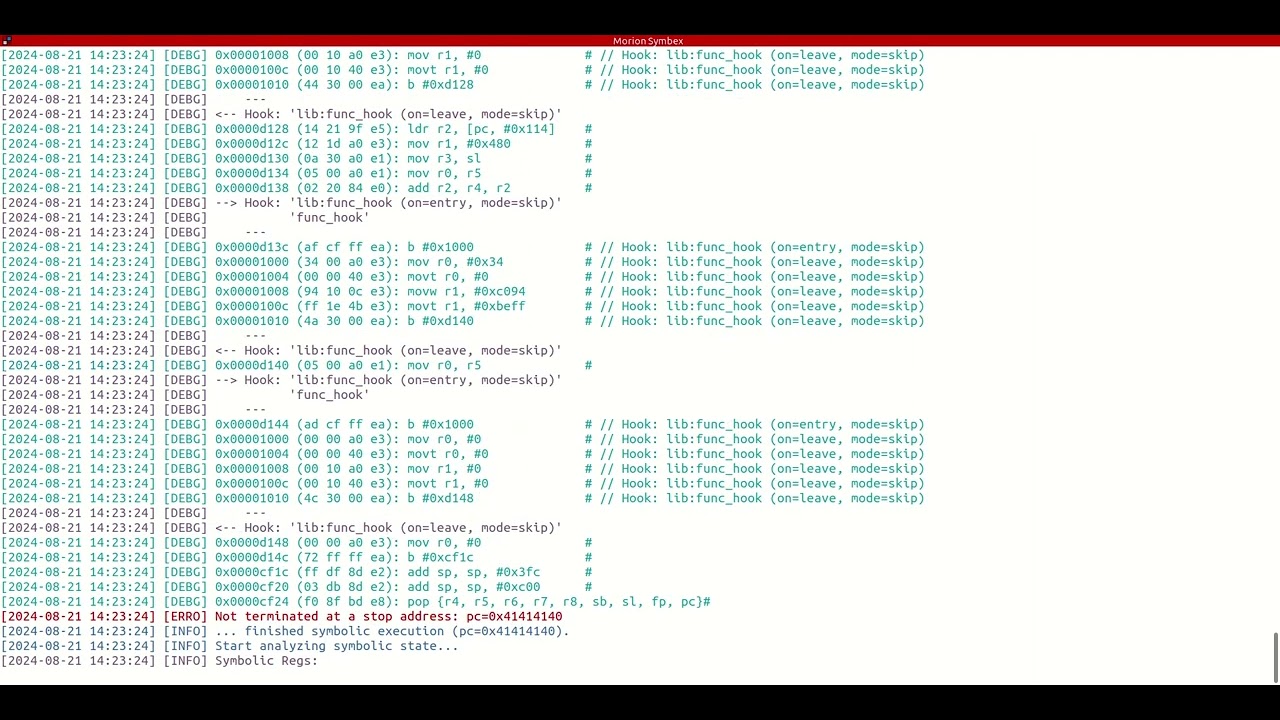
DEMO Symbolic_Execution/Run - Click the image below to watch on YouTube:
Analysis Modules
Morion implements different analysis modules that are based on symbolic execution. The chosen design attempts to make Morion easily extendable with new modules. The currently implemented ones are summarized in the table below:
| Module | Description |
|---|---|
| morion | Perform symbolic execution on a binary's program trace. |
| morion_backward_slicer | Symbolically execute a program trace for backward slicing. The analysis identifies backward slices for a specified register or memory address. |
| morion_branch_analyzer | Symbolically execute a program trace for branch analysis. The analysis identifies multi-way branches along the trace and outputs concrete values of how to reach the non-taken branch. A specific branch is only evaluated once. |
| morion_path_analyzer | Symbolically execute a program trace for path analysis. The analysis identifies unique paths along the trace and outputs concrete values of how to reach these paths. A path consists of a sequence of multi-way branches. The last multi-way branch in each outputted path is non- taken in the concrete execution of the trace. |
| morion_memory_hijacker | Symbolically execute a program trace to identify potential memory hijacks. A memory hijack corresponds to the target of a memory read or write operation being (partly) symbolic. |
| morion_control_hijacker | Symbolically execute a program trace to identify potential control flow hijacks. A control flow hijack corresponds to registers, influencing the control flow (such as pc), becoming (partly) symbolic. |
| morion_rop_generator | Symbolically execute a program trace to help generating a ROP chain. |
Discussion
In the following, we discuss some aspects of the symbolic execution process as implemented by Morion.
Loading the Trace File
As explained in section Tracing: Collecting the Trace, beside
the executed assembly instructions, the initial concrete values of all registers and/or memory
locations accessed within the trace are recorded (in our specific example in the file
circled.yaml). Before starting the actual symbolic execution, these are used by
Morion to initialize the corresponding concrete
register and/or memory values within the context of the symbolic execution engine (which in our case
is Triton). This assures that the symbolic execution of the
recorded trace uses the correct concrete register and/or memory values. This initialization of
registers and/or memory locations can be observed in
Morion's debug output:
[2024-08-20 14:16:43] [INFO] Start loading file 'circled.yaml'...
[2024-08-20 14:16:45] [DEBG] Regs:
[2024-08-20 14:16:45] [DEBG] 	n=0x0
[2024-08-20 14:16:45] [DEBG] 	r0=0x21a90
[2024-08-20 14:16:45] [DEBG] 	r1=0x1
[2024-08-20 14:16:45] [DEBG] 	r10=0xbeffc514
[2024-08-20 14:16:45] [DEBG] 	r11=0xbeffcd14
[2024-08-20 14:16:45] [DEBG] 	r2=0x258
[2024-08-20 14:16:45] [DEBG] 	r3=0x0
[2024-08-20 14:16:45] [DEBG] 	r4=0x1b850
[2024-08-20 14:16:45] [DEBG] 	r5=0xbeffd078
[2024-08-20 14:16:45] [DEBG] 	r6=0xbeffcf14
[2024-08-20 14:16:45] [DEBG] 	r7=0xbeffce14
[2024-08-20 14:16:45] [DEBG] 	r8=0x21a90
[2024-08-20 14:16:45] [DEBG] 	r9=0xffff68a8
[2024-08-20 14:16:45] [DEBG] 	sp=0xbeffc080
[2024-08-20 14:16:45] [DEBG] 	v=0x0
[2024-08-20 14:16:45] [DEBG] 	z=0x0
[2024-08-20 14:16:45] [DEBG] Mems:
[2024-08-20 14:16:45] [DEBG] 	0x0000d230=0xbc
[2024-08-20 14:16:45] [DEBG] 	0x0000d231=0x6a j
[2024-08-20 14:16:45] [DEBG] 	0x0000d232=0xff
[2024-08-20 14:16:45] [DEBG] 	0x0000d233=0xff
[...]
[2024-08-20 14:16:45] [DEBG] 	0x000120f8=0x25 %
[2024-08-20 14:16:45] [DEBG] 	0x000120f9=0x73 s
[2024-08-20 14:16:45] [DEBG] 	0x000120fa=0x20
[2024-08-20 14:16:45] [DEBG] 	0x000120fb=0x25 %
[2024-08-20 14:16:45] [DEBG] 	0x000120fc=0x73 s
[2024-08-20 14:16:45] [DEBG] 	0x000120fd=0x00
[...]
[2024-08-20 14:16:45] [DEBG] 	0xbeffc914=0x00
[2024-08-20 14:16:45] [DEBG] 	0xbeffd07c=0x41 A
[2024-08-20 14:16:45] [DEBG] 	0xbeffd07d=0x41 A
[...]
[2024-08-20 14:16:45] [DEBG] 	0xbeffd09e=0x41 A
[2024-08-20 14:16:45] [DEBG] 	0xbeffd09f=0x41 A
[...]
In a similar manner, registers and/or memory locations can be assigned a new symbolic variable,
before the actual symbolic execution of the trace begins. To for example mark the register r0 as
being symbolic (alongside its concrete initial value of 0x21a90), the trace file circled.yaml
(respectively the file circled.init.yaml) could contain an entry such
as the one shown below:
[...]
states:
  entry:
    regs:
      'r0': ['0x21a90', '$$$$$$$$']   # Marking register r0 as being symbolic
      [...]
    mems:
      '0x000120f8': ['0x25', '$$']    # Marking memory location 0x120f8 as being symbolic
      [...]
[...]
As can be seen in the excerpt above, Morion uses
the specifier $$ for referring to a symbolic byte. In the above example, where a symbolic
register and a symbolic memory location were defined,
Morion's debug output, while loading the trace
file, would look like this:
[...]
[2024-08-20 14:16:45] [DEBG] 	r0=0x21a90
[2024-08-20 14:16:45] [DEBG] 	r0=$$$$$$$$
[...]
[2024-08-20 14:16:45] [DEBG] 	0x000120f8=0x25 %
[2024-08-20 14:16:45] [DEBG] 	0x000120f8=$$
[...]
Note that in our example of binary circled, we do not manually mark any register and/or memory
location as being symbolic (there are no $$ specifiers in the entry state of file
circled.init.yaml). Instead, and as will be explained in section
Symbex: How Hooking Works below, all symbolic variables are
automatically introduced by Morion and its model
for the hooked libc function fgets.
After initializing concrete and/or symbolic values of all necessary registers and/or memory locations in the context of the symbolic execution engine, Morion sets up the defined function hooks:
[...]
[2024-08-20 14:16:45] [DEBG] Hooks:
[2024-08-20 14:16:45] [DEBG] 	0x0000d040: 'lib:func_hook (on=entry, mode=skip)'
[2024-08-20 14:16:45] [DEBG] 	0x0000d044: 'lib:func_hook (on=leave, mode=skip)'
[...]
[2024-08-20 14:16:45] [DEBG] 	0x0000c9c4: 'lib:func_hook (on=entry, mode=skip)'
[2024-08-20 14:16:45] [DEBG] 	0x0000c9c8: 'lib:func_hook (on=leave, mode=skip)'
[2024-08-20 14:16:45] [DEBG] 	0x0000cfe0: 'libc:fgets (on=entry, mode=model)'
[2024-08-20 14:16:45] [DEBG] 	0x0000cfe4: 'libc:fgets (on=leave, mode=model)'
[2024-08-20 14:16:45] [DEBG] 	0x0000d094: 'libc:fgets (on=entry, mode=model)'
[2024-08-20 14:16:45] [DEBG] 	0x0000d098: 'libc:fgets (on=leave, mode=model)'
[2024-08-20 14:16:45] [DEBG] 	0x0000cffc: 'libc:sscanf (on=entry, mode=model)'
[2024-08-20 14:16:45] [DEBG] 	0x0000d000: 'libc:sscanf (on=leave, mode=model)'
[2024-08-20 14:16:45] [INFO] ... finished loading file 'circled.yaml'.
[...]
How hooking works, while executing a trace symbolically, is explained next.
How Hooking Works
We already discussed how hooking works during tracing in section Tracing: How Hooking Works. Here, we discuss some aspects about hooking while executing a trace symbolically.
Abstract Function Hook with Mode Skip (Example libc:fclose)
In the chapter about tracing (see section
Tracing: How Hooking Works), we have already seen that the file
circled.init.yaml defines a hook for entry and leave addresses
0xd040 and 0xd044, respectively. The hook corresponds to a call to function fclose (synopsis:
int fclose(FILE *stream);) from libc (or to be more specific, uclibc in case of the binary
circled). Due to the hooking, the effective assembly instructions of the function itself have not
been traced. Instead Morion injected some
instructions to reproduce some of the function's side-effects. Since we used an
abstract function hook (hooks:lib:func_hook:), the only modelled side-effect corresponds to
setting the correct return value(s). For the ARMv7 architecture that we target, a function's return
value is generally stored in register r0 (and potentially r1). This is exactly what instructions
0x1000 - 0x100c are used for. Morion injected
assembly instructions to move the trace's effective return value of function fclose (here 0,
meaning a successful closure of the corresponding file stream) to the return register(s).
[...]
[2024-08-20 14:16:46] [DEBG] 0x0000d03c (08 00 a0 e1): mov r0, r8
[2024-08-20 14:16:46] [DEBG] --> Hook: 'lib:func_hook (on=entry, mode=skip)'
[2024-08-20 14:16:46] [DEBG]           'func_hook'
[2024-08-20 14:16:46] [DEBG]     ---
[2024-08-20 14:16:46] [DEBG] 0x0000d040 (ee cf ff ea): b #0x1000               # // Hook: lib:func_hook (on=entry, mode=skip)
[2024-08-20 14:16:46] [DEBG] 0x00001000 (00 00 a0 e3): mov r0, #0              # // Hook: lib:func_hook (on=leave, mode=skip)
[2024-08-20 14:16:46] [DEBG] 0x00001004 (00 00 40 e3): movt r0, #0             # // Hook: lib:func_hook (on=leave, mode=skip)
[2024-08-20 14:16:46] [DEBG] 0x00001008 (01 10 a0 e3): mov r1, #1              # // Hook: lib:func_hook (on=leave, mode=skip)
[2024-08-20 14:16:46] [DEBG] 0x0000100c (00 10 40 e3): movt r1, #0             # // Hook: lib:func_hook (on=leave, mode=skip)
[2024-08-20 14:16:46] [DEBG] 0x00001010 (0b 30 00 ea): b #0xd044               # // Hook: lib:func_hook (on=leave, mode=skip)
[2024-08-20 14:16:46] [DEBG]     ---
[2024-08-20 14:16:46] [DEBG] <-- Hook: 'lib:func_hook (on=leave, mode=skip)'
[2024-08-20 14:16:46] [DEBG] 0x0000d044 (04 30 9d e5): ldr r3, [sp, #4]
[...]
When running a trace symbolically, Morion follows
along the recorded instructions (including the ones injected by hooks during tracing) and executes
them one by one using its underlying symbolic execution engine
(Triton in our case). For hooks with mode skip, no additional
modifications of the symbolic state are performed. As we will see in the next example, this might be
different when using a hook with mode model.
Specific Function Hook with Mode Model (Example libc:fgets)
As mentioned in section Tracing: How Hooking Works, the file
circled.init.yaml, beside others, also defines a hook for entry and
leave addresses 0xcfe0 and 0xcfe4, respectively. The hook is intended to catch calls to
function fgets (synopsis: char *fgets(char *s, int n, FILE *stream)) of library uclibc. Again,
due to the hooking, the effective assembly instructions of the function itself have not been
recorded during tracing. Instead, some instructions got injected to reproduce the side-effects
that the function has on the memory and register contexts. When looking closely to the injected
instructions, one observes that first the effective bytes of string s are set
(0xbeffc914: 0x41 'A' - 0xbeffcd12: 0x58 'X', 0xbeffcd13: 0x00), and second the
correct return value (0xbeffc914 - the address of string s) is placed into register r0. In
contrast to an abstract function hook (hooks:lib:func_hook:) where only instructions to handle
correct function return values are injected, specific function hooks (hooks:libc:fgets) handle
additional function-specific side-effects to the memory and register contexts.
[...]
[2024-08-20 14:16:45] [INFO] Start symbolic execution...
[2024-08-20 14:16:45] [DEBG] 0x0000cfc0 (64 37 65 e5): strb r3, [r5, #-0x764]!
[...]
[2024-08-20 14:16:45] [DEBG] 0x0000cfdc (05 00 a0 e1): mov r0, r5
[2024-08-20 14:16:45] [DEBG] --> Hook: 'libc:fgets (on=entry, mode=model)'
[2024-08-20 14:16:45] [DEBG]           'char *fgets(char *restrict s, int n, FILE *restrict stream);'
[2024-08-20 14:16:45] [DEBG] 	 s = 0xbeffc914
[2024-08-20 14:16:45] [DEBG] 	 n = 1024
[2024-08-20 14:16:45] [DEBG] 	 stream = 0x00021a90
[2024-08-20 14:16:45] [DEBG]     ---
[2024-08-20 14:16:45] [DEBG] 0x0000cfe0 (06 d0 ff ea): b #0x1000               # // Hook: libc:fgets (on=entry, mode=model)
[2024-08-20 14:16:45] [DEBG] 0x00001000 (14 09 0c e3): movw r0, #0xc914        # // Hook: libc:fgets (on=leave, mode=model)
[2024-08-20 14:16:45] [DEBG] 0x00001004 (ff 0e 4b e3): movt r0, #0xbeff        # // Hook: libc:fgets (on=leave, mode=model)
[2024-08-20 14:16:45] [DEBG] 0x00001008 (41 10 a0 e3): mov r1, #0x41           # // Hook: libc:fgets (on=leave, mode=model)
[2024-08-20 14:16:45] [DEBG] 0x0000100c (00 10 40 e3): movt r1, #0             # // Hook: libc:fgets (on=leave, mode=model)
[2024-08-20 14:16:45] [DEBG] 0x00001010 (00 10 c0 e5): strb r1, [r0]           # // Hook: libc:fgets (on=leave, mode=model)
[...]
[2024-08-20 14:16:46] [DEBG] 0x00005fd8 (12 0d 0c e3): movw r0, #0xcd12        # // Hook: libc:fgets (on=leave, mode=model)
[2024-08-20 14:16:46] [DEBG] 0x00005fdc (ff 0e 4b e3): movt r0, #0xbeff        # // Hook: libc:fgets (on=leave, mode=model)
[2024-08-20 14:16:46] [DEBG] 0x00005fe0 (58 10 a0 e3): mov r1, #0x58           # // Hook: libc:fgets (on=leave, mode=model)
[2024-08-20 14:16:46] [DEBG] 0x00005fe4 (00 10 40 e3): movt r1, #0             # // Hook: libc:fgets (on=leave, mode=model)
[2024-08-20 14:16:46] [DEBG] 0x00005fe8 (00 10 c0 e5): strb r1, [r0]           # // Hook: libc:fgets (on=leave, mode=model)
[2024-08-20 14:16:46] [DEBG] 0x00005fec (13 0d 0c e3): movw r0, #0xcd13        # // Hook: libc:fgets (on=leave, mode=model)
[2024-08-20 14:16:46] [DEBG] 0x00005ff0 (ff 0e 4b e3): movt r0, #0xbeff        # // Hook: libc:fgets (on=leave, mode=model)
[2024-08-20 14:16:46] [DEBG] 0x00005ff4 (00 10 a0 e3): mov r1, #0              # // Hook: libc:fgets (on=leave, mode=model)
[2024-08-20 14:16:46] [DEBG] 0x00005ff8 (00 10 40 e3): movt r1, #0             # // Hook: libc:fgets (on=leave, mode=model)
[2024-08-20 14:16:46] [DEBG] 0x00005ffc (00 10 c0 e5): strb r1, [r0]           # // Hook: libc:fgets (on=leave, mode=model)
[2024-08-20 14:16:46] [DEBG] 0x00006000 (14 09 0c e3): movw r0, #0xc914        # // Hook: libc:fgets (on=leave, mode=model)
[2024-08-20 14:16:46] [DEBG] 0x00006004 (ff 0e 4b e3): movt r0, #0xbeff        # // Hook: libc:fgets (on=leave, mode=model)
[2024-08-20 14:16:46] [DEBG] 0x00006008 (f5 1b 00 ea): b #0xcfe4               # // Hook: libc:fgets (on=leave, mode=model)
[2024-08-20 14:16:46] [DEBG] 	 s = 0xbeffc914
[2024-08-20 14:16:46] [DEBG] 	*s = 'AAA[...]AAA X'
[2024-08-20 14:16:46] [DEBG] 	0xbeffc914 = $$
[2024-08-20 14:16:46] [DEBG] 	...
[2024-08-20 14:16:46] [DEBG] 	0xbeffcd12 = $$
[2024-08-20 14:16:46] [DEBG]     ---
[2024-08-20 14:16:46] [DEBG] <-- Hook: 'libc:fgets (on=leave, mode=model)'
[2024-08-20 14:16:46] [DEBG] 0x0000cfe4 (00 00 50 e3): cmp r0, #0
[...]
[2024-08-20 14:16:46] [DEBG] 0x0000cf20 (03 db 8d e2): add sp, sp, #0xc00
[2024-08-20 14:16:46] [DEBG] 0x0000cf24 (f0 8f bd e8): pop {r4, r5, r6, r7, r8, sb, sl, fp, pc
[2024-08-20 14:16:46] [INFO] ... finished symbolic execution (pc=0x41414140).
[...]
Since we defined a function-specific hook to be used with mode model, additional modifications to
the symbolic state might be performed. These modifications can happen either at entry or when
leaving the hook. The model implementation of fgets (see
libc.py#L12
for more details), for instance, makes the string s symbolic. This means that new symbolic
variables get assigned to each character/byte of the read string.
But why does one want to make s symbolic?
Well, s is read in from a resource external to the targeted binary (here a file), which is
potentially controllable by a (malicious) user. By making s symbolic we might conduct various
analysis about how it, respectively an attacker, can influence our target program. As will be
explained in the next section Analyzing Symbolic State, in
the case of binary circled, we for instance immediately see that the program counter (pc) at the
end of the trace is symbolic. Phrased differently, the pc can (somehow) be influenced by
attacker-controllable values, potentially leading to control-flow hijacking attacks.
Note: In case you want to hook invocations of function fgets without making the read string
symbolic, define the corresponding hook to use mode skip.
Note: Morion is a proof-of-concept (PoC)
tool intended to be used for experimenting with symbolic execution on (real-world) (ARMv7) binaries.
It currently implements (only) a handful of hooks for common libc functions. These should be
extended in future work.
Analyzing Symbolic State
If we symbolize inputs that an attacker can control, symbolic execution not only allows us to see
which parts of a target binary can be influenced, but also how this may happen. At the end of a
symbolic execution run, Morion for instance
analyzes the symbolic state (can be disabled using option --skip_state_analysis). This means
that an overview is given about which registers and memory locations are based on symbolic
variable(s). In the example of the collected trace of binary circled, one immediately sees that
the program counter (register pc) is one of these candidates. Remember that we only marked inputs
an attacker might control as being symbolic, meaning that an attacker can potentially influence the
program's control-flow.
[...]
[2024-08-20 14:16:46] [INFO] Start analyzing symbolic state...
[2024-08-20 14:16:46] [INFO] Symbolic Regs:
[2024-08-20 14:16:46] [INFO] 	pc=$$$$$$$$
[2024-08-20 14:16:46] [INFO] 	r10=$$$$$$$$
[2024-08-20 14:16:47] [INFO] 	r11=$$$$$$$$
[2024-08-20 14:16:47] [INFO] 	r4=$$$$$$$$
[2024-08-20 14:16:47] [INFO] 	r5=$$$$$$$$
[2024-08-20 14:16:47] [INFO] 	r6=$$$$$$$$
[2024-08-20 14:16:47] [INFO] 	r7=$$$$$$$$
[2024-08-20 14:16:48] [INFO] 	r8=$$$$$$$$
[2024-08-20 14:16:48] [INFO] 	r9=$$$$$$$$
[2024-08-20 14:16:48] [INFO] Symbolic Mems:
[2024-08-20 14:17:56] [INFO] 	0xbeffc914=$$
[2024-08-20 14:17:56] [INFO] 	...
[2024-08-20 14:17:56] [INFO] 	0xbeffcd12=$$
[2024-08-20 14:17:56] [INFO] 	0xbeffce14=$$
[2024-08-20 14:17:56] [INFO] 	0xbeffcf14=$$
[2024-08-20 14:17:56] [INFO] 	...
[2024-08-20 14:17:56] [INFO] 	0xbeffd310=$$
[2024-08-20 14:17:56] [INFO] ... finished analyzing symbolic state.
[2024-08-20 14:17:56] [INFO] Start storing file 'circled.yaml'...
[2024-08-20 14:17:58] [INFO] ... finished storing file 'circled.yaml'.
In chapter Exploitation, we will see how symbolic execution might help us to decide whether the crasher we traced might be exploitable or not, i.e. corresponds to an actual security vulnerability or just an annoying bug. We will also see, how symbolic execution can quickly give us a first high-level intuition about what capabilities (e.g. arbitrary read/write, control-flow hijacking, etc.) one might gain with the underlying issue. Also, we will show how symbolic execution might help us during the process of generating a working exploit for the targeted vulnerability (CVE-2022-27646).